Passive fire protection
The parts of a building that hold a fire back without anyone having to do anything.
- Every seal labelled and photographed
- BM TRADA / FIRAS-certificated contractors
- Written price before any work
Passive fire protection is the name for the parts of a building that slow the spread of fire and smoke simply by being there. Compartment walls and floors. Fire doors and their frames. Fire stopping around pipes and cables. Cavity barriers in hidden voids. Fire dampers in ductwork. Fire protection on structural steel, such as boards or intumescent paint. Active fire protection, by contrast, has to switch on, like alarms, sprinklers and smoke vents.
The passive parts only work as a set. A one-hour wall with a 50mm gap around a soil pipe is not a one-hour wall. A fire door in perfect order is undone by an open riser beside it. That is why fire risk assessments for blocks of flats now look harder at compartmentation than they did ten years ago. Since the Fire Safety Act 2021, the Regulatory Reform (Fire Safety) Order 2005 has made it clear that in a building with two or more flats the duty covers the structure, the external walls and the flat entrance doors, as well as the common parts.
What we carry out
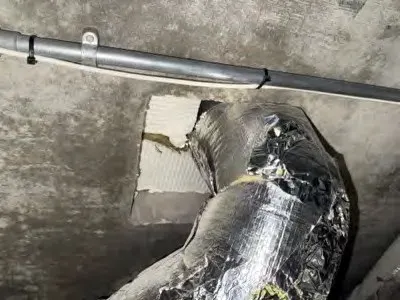
Our work on these sites is fire stopping. That covers compartmentation surveys, sealing around pipes, cables and ducts, fire collars and wraps, linear gaps at the head of walls and cavity barriers. The installation is carried out by our BM TRADA / FIRAS-certificated contractors.
We do not install fire dampers or structural steel protection. Fire doors are a separate service with their own inspection. If a survey turns up a damper with no access panel or a steel beam with damaged boarding, it goes in the report as an item for the right specialist.
Where to start
If your fire risk assessment has a line about compartmentation, start with that line and the plans. Send both to us with the postcode, the number of floors and how to get into the risers. That is enough for us to tell you whether a survey is needed first or whether the sealing can be priced straight away.
Send us the postcode, the number of floors and the page of the assessment that mentions it. We come back with what it needs and a written price.