What is a fire batt?
- Every seal labelled and photographed
- BM TRADA / FIRAS-certificated contractors
- Written price before any work
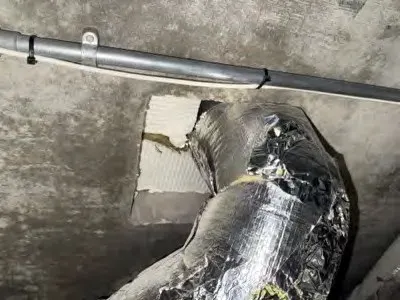
A fire batt is a slab of high-density mineral wool, usually 50 or 60mm thick, coated on both faces with a grey or white fire-resistant coating. You will see them in risers and ceiling voids, cut to fill a large opening in a wall or floor with cable trays, ducts or a cluster of pipes passing through. They are the usual answer when a hole is too big for mastic alone.
The batt is cut to fit the opening tightly, then cut again around each service that passes through. All the joints, the edges against the wall and the gaps around the services are sealed with a mastic from the same tested system. Plastic pipes passing through a batt still need their own collars or wraps. In some tested details a single batt is enough for 60 minutes, in others two batts are fitted with a gap between them, one on each face of the wall.
Batts are soft and easy to damage. The usual fault is a new cable pushed through a finished batt by poking a screwdriver through it first, with no mastic round the cable afterwards. A batt with holes punched in it, or one that has been cut into pieces to get a tray through and never put back, is no longer a seal.
Send us the postcode, the number of floors and the page of the assessment that mentions it. We come back with what it needs and a written price.